


Learn
Rupee at 96.73: What a Weak Rupee Actually Costs You
Rupee at 96.73/$, near its record low. RBI's Saturday plan: four support measures. How a weak rupee hits fuel, gold, inflation and foreign spending.
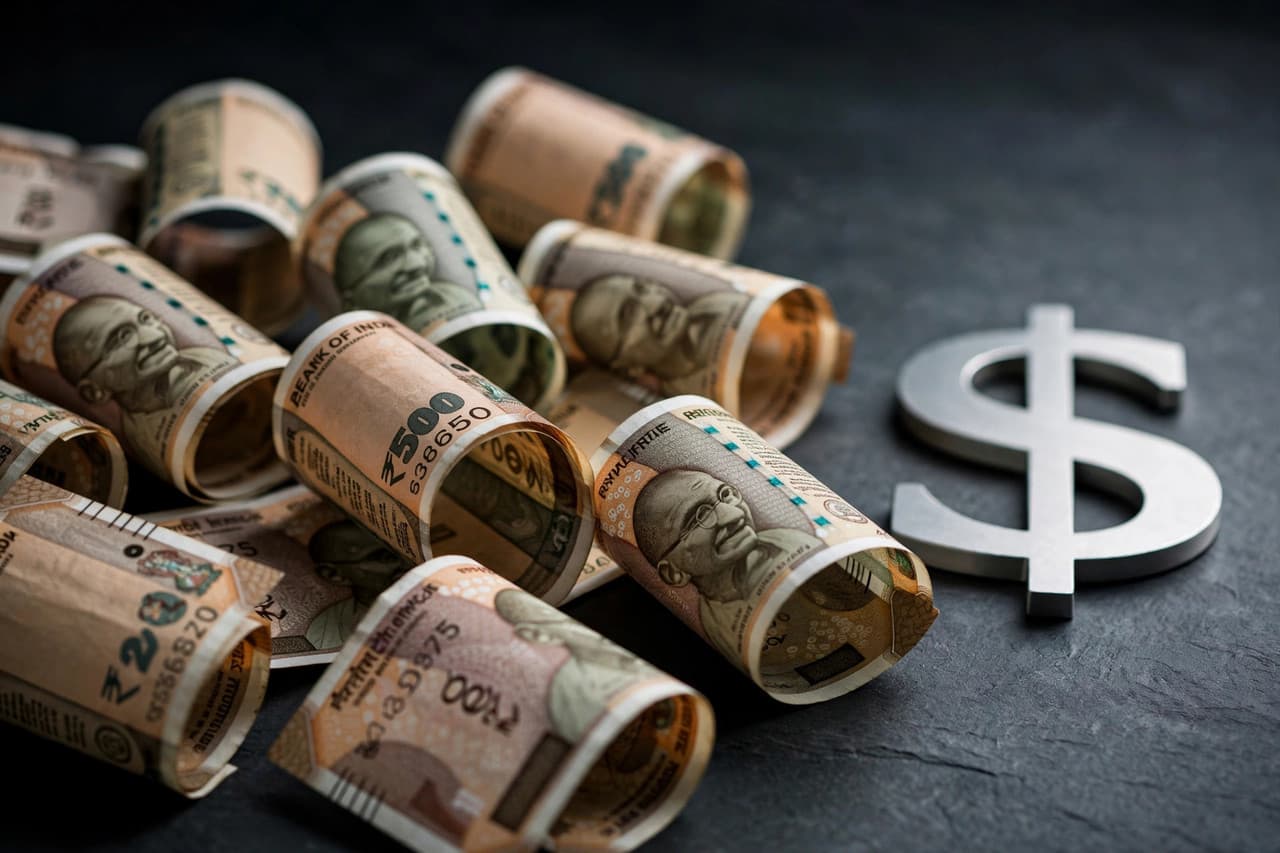
On Saturday 10 October 2026, the RBI announced four measures to steady the rupee — a special dollar window for three oil companies from Monday, a ban on rebooking cancelled forex contracts, a $5 million cap on no-exposure derivatives, and a 20% risk reserve. The rupee closed Friday at 96.73, near its all-time low of 96.96.
Why the rupee is sliding
The rupee closed on Friday at 96.73 to the US dollar. That is not a record low — the all-time weakest level stands at 96.96, touched in May 2026 — but it is uncomfortably close. The currency is down more than 7% in calendar 2026 and about 3.5% so far in FY27.
Three verified pressures are at work:
• Crude is running hot. Brent is trading above $102 a barrel. India meets roughly 88% of its crude-oil consumption through imports (PPAC data), so expensive oil translates directly into a bigger dollar bill — more dollars bought, more pressure on the rupee.
• Foreign investors are pulling money out. FIIs sold equities worth ₹6,121 crore on 8 October alone. When foreign money leaves, rupees are converted into dollars on the way out, adding to the slide.
• Policy is tightening. On 7 October, the RBI raised the repo rate to 5.50% in what it called "calibrated tightening" — a signal that inflation risks are being taken seriously, but rate decisions alone cannot shield a currency from global flows.
Markets are closed today (Saturday), but the one-month dollar/rupee NDF contract — which keeps trading offshore — rallied around 40 paise in thin trading after the RBI's announcement. The early signal is that markets noticed the intervention.
The RBI's four measures, in plain English
Central banks rarely announce currency measures on a Saturday. When they do, it means they want the market to wake up Monday with a new script. Here is what the RBI's package actually does, minus the jargon:
1. A special dollar window for oil companies. Starting Monday 12 October, the RBI will meet the entire daily dollar requirements of three public-sector oil marketing companies — Indian Oil, Hindustan Petroleum and Bharat Petroleum — directly from forex reserves, selling dollars through designated banks "until further notice". Oil companies are the single biggest source of dollar demand in the Indian market; taking them off the spot market removes a huge daily buyer, which should calm prices. The trade-off, as ANZ strategist Dhiraj Nim noted, is that this will show up as reserve depletion.
2. No rebooking of cancelled contracts. Authorised dealers can no longer let users rebook an INR forex derivative contract (deliverable or non-deliverable) once it has been cancelled after the new Directions take effect. Rollover at maturity is still permitted. In simple terms: you cannot cancel a currency bet and immediately place it again to keep speculating on the rupee's fall.
3. A $5 million cap on speculative positions. The threshold for forex derivative transactions done without any underlying exposure has been cut from $100 million to $5 million. Separately, exchange-traded currency-derivative positions involving the rupee are capped at $5 million equivalent across all recognised stock exchanges. This is a direct squeeze on speculative bets against the rupee.
4. A 20% cash reserve on rupee bets. A new "Foreign Exchange Risk Reserve" requires 20% of the notional amount to be set aside on rupee-linked derivative contracts. Making speculation more expensive is the oldest trick in the central-banking book — and it usually works on the margins.
What a weaker rupee does to your wallet
You never touch the dollar/rupee rate directly, but it quietly rewrites the prices of things you buy. Here is the chain, explained with the mechanics rather than the fear:
Fuel and transport. Roughly 88% of India's crude is imported, and crude is bought in dollars. When the rupee weakens and Brent sits above $102, the rupee cost of every imported barrel rises. That pressure eventually feeds into fuel and transport costs, which then leak into the price of almost everything that moves by road — including groceries.
Everyday imported goods. A weaker rupee makes imports costlier in rupee terms. The items where this shows up fastest are the ones India imports heavily: edible oils, electronics, and imported components inside "made in India" products. That is imported inflation, and it lands in household budgets quietly.
Gold. Gold is priced in dollars globally. So even if the international gold price does not move, a weaker rupee makes the same gram of gold costlier for an Indian buyer. Anyone planning festival-season jewellery purchases feels the currency move directly in the bill.
Studying or travelling abroad. If you are budgeting for a foreign degree, paying university fees, or booking an international trip, every dollar of spending now costs more rupees. A $30,000 annual tuition bill costs about ₹1.05 lakh more at 96.73 than it would have at 93.25 — the same education, a bigger rupee cheque.
One tailwind worth understanding. For IT services exporters — companies that earn revenue in dollars and pay costs in rupees — a weaker rupee mechanically widens the gap between what they earn and what they spend. That is simply how the arithmetic works; it is a mechanism, not an investment call, and individual company results depend on far more than the exchange rate.
What it does NOT mean
A few things this moment is not, because headlines often blur them:
• Today is not a record low. The rupee closed Friday at 96.73; the all-time weakest remains 96.96 from May 2026. "Near the record" is accurate; "record low" is not.
• This is not a prediction. Currency support measures aim to reduce volatility and speculative pressure; they do not promise a particular exchange-rate level, and nobody — including the RBI — can guarantee where the rupee trades next.
• Markets are closed today. The 40-paise NDF move in thin Saturday trading is a directional whisper, not a Monday verdict. The real test begins when the dollar window opens on 12 October.
• A falling rupee is not automatically a crisis. It reflects crude prices, capital flows and global dollar strength as much as anything domestic. What matters for you is the transmission into prices — and understanding that transmission is exactly what lets you plan calmly.
Paired reading: our 7 October Investing & Markets piece on the rupee–rate-hike paradox explains the other half of this story — why the RBI raised rates even as the currency slid. Rupee Falls to 96.78 Despite RBI Hike: What It Means for You.
Frequently asked questions
Why is the rupee falling in 2026?
What did the RBI announce on 10 October 2026?
Is the rupee at its lowest level ever today?
How does a weak rupee affect a common household?
Will the RBI's measures strengthen the rupee?
Should I buy dollars or gold because the rupee is falling?
Your move this week
Spend 15 minutes doing one practical exercise: look at the next 90 days and list every rupee-denominated commitment you have that is actually priced in dollars — an education-fee instalment, a planned international trip, a foreign subscription, a wedding-season gold purchase. For each, work out the rupee cost at 96.73 versus the rate you had originally assumed. That single comparison turns an abstract currency headline into a concrete budget number — and budgeting, not forecasting, is the part you control.
Learn MoreReuters: India central bank takes steps to support rupee, opens dollar window for oil companies
The Hindu BusinessLine: RBI steps up rupee support, opens dollar window for oil companies
Times Now: RBI opens dollar window for 3 PSU oil firms amid rising oil prices, rupee pressure
DT Next: RBI announces special dollar window for 3 public sector OMCs
This article is for educational purposes only and is not financial advice. Please consult a SEBI-registered investment adviser for personalized guidance. Investments are subject to market risk.
Discussion
KEEP EXPLORING
More in Learn Your next good read.
Learn
Sensex Fell 1,045 Thursday, Rose 879 Friday: What Two Wild Days Teach You About Staying Invested
8 min read
LearnTCS Pays ₹12 a Share: How Dividends Reach Your Account — Record Date, Ex-Date, TDS
8 min read
LearnEmergency Fund: The Exact Number for Your Salary — and Where to Keep It
8 min read
LearnDigital Fraud? RBI's New Rule: Who Pays Now (Jan 2027)
6 min read