


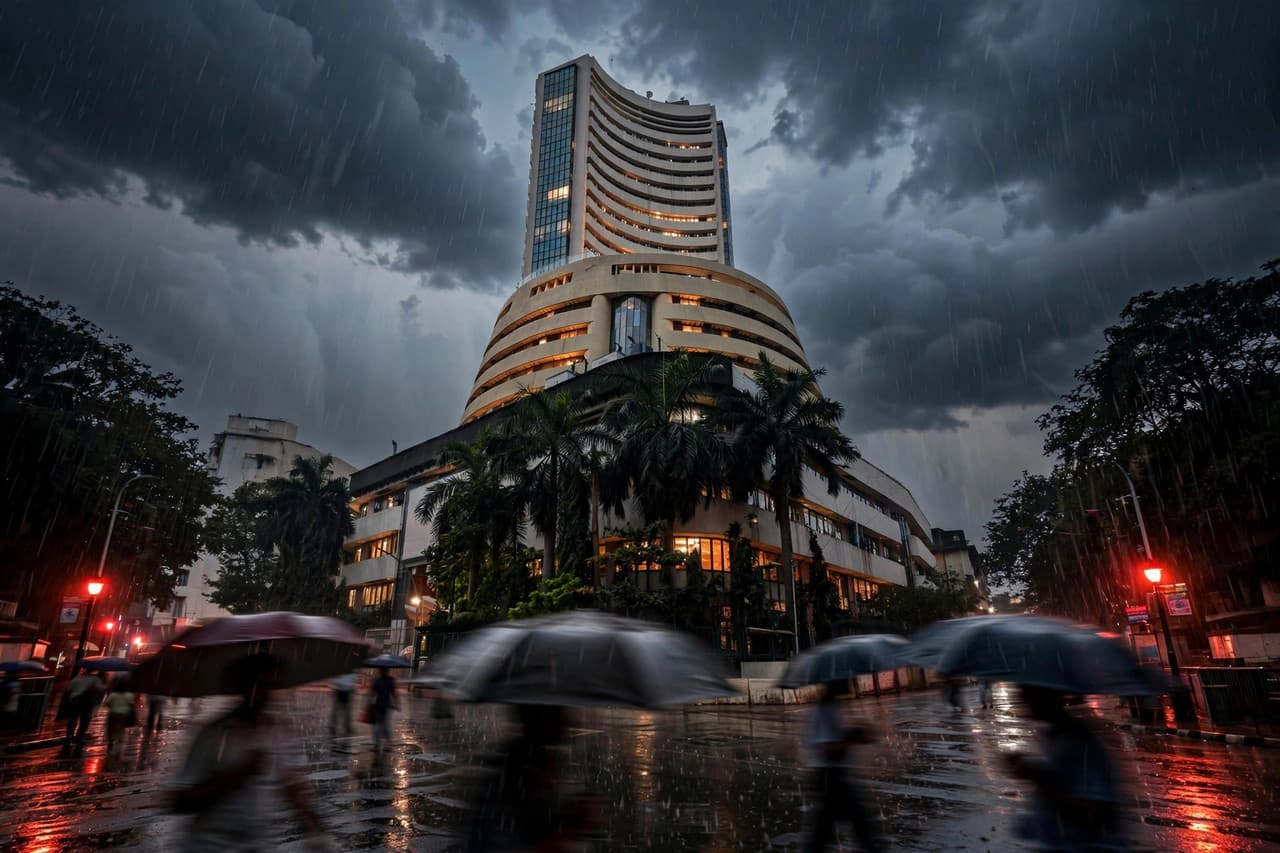
The market gave back a month of gains in a single session. The Sensex fell 1,483.72 points (1.77%) to 82,435.99 on Monday 23 November 2026, and the Nifty dropped 450.95 points (1.75%) to 25,349.65 — the biggest single-day fall in five months, snapping a four-week rally. Investors lost about ₹5.18 lakh crore in market value in one day. If you invest through SIPs, here is what actually happened, why it happened, and what to do tonight.
Quick Answer: The Sensex fell 1,483.72 points (1.77%) to 82,435.99 and the Nifty 450.95 points (1.75%) to 25,349.65 on Monday 23 November 2026, the worst single-day fall in five months. For SIP investors, one red day changes nothing about the plan — it buys the same ₹10,000 instalment about 1.8% more units. Check your allocation, not the ticker.
What happened today
The fall was broad, not narrow. Banking and metal stocks led the selling: Bank Nifty fell more than 3% to 62,585, giving back part of its run to Friday's record 64,635.20, and Nifty Metal was the worst sectoral index of the day. Tata Steel was the biggest Nifty loser, down 8.16%, after its ₹15,511 crore deal to buy a 26.38% stake in APL Apollo Tubes. Axis Bank fell 3.95%, ICICI Bank 3.39%, HDFC Bank 3.22%, State Bank of India 2.91% and Kotak Mahindra Bank 2.52%. Midcaps fell 0.92% and smallcaps 0.69% — the selling reached beyond the frontline stocks. Only IT and realty ended in positive territory.
The total market value of BSE-listed companies fell from ₹5,14,18,274.69 crore on Friday to ₹5,08,99,889.45 crore — a loss of about ₹5.18 lakh crore in a day, according to BSE data. The rupee weakened too, closing at 92.92 to the dollar after touching 93.11 during the day. Gold moved the other way: MCX gold futures rose about 2.4% to ₹1,24,709, as investors looked for safety.
Why it fell: four reasons, not one
First, the global AI sell-off. Wall Street fell hard on Friday — the Nasdaq crashed 5.28% and the S&P 500 fell 3.70% — as investors questioned stretched valuations of artificial-intelligence stocks and the debt-funded data-centre spending behind them. Japan's Nikkei fell 5.06% and Korea's Kospi 4.92% on the same day. Indian markets were shut for the weekend when the selling hit, so Monday carried the full catch-up.
Second, US interest-rate worries. Markets now expect the US Federal Reserve to raise rates at its December meeting, with Fed funds futures putting the odds at about 89%. Higher US rates pull money toward dollar assets and away from emerging markets like India.
Third, profit booking at a psychological level. The Nifty had come close to 26,000 after four straight weeks of gains, and investors chose to lock in profits — a normal reaction after a sharp rally, not a verdict on the economy. Analysts also pointed to monthly derivatives expiry and a holiday-shortened week: markets are shut on Tuesday 24 November for Guru Nanak Jayanti.
Fourth, the Tata Steel deal. The steelmaker's plan to take control of APL Apollo Tubes — up to ₹32,266 crore including the open offer — pushed its own shares down 8.16% and dragged the metal index with it. The deal itself is a separate story; today it was simply one more weight on an already falling market.
The worked example: what minus 1.75% does to your money
Percentages hide the rupees. A ₹1 lakh portfolio tracking the Nifty was worth ₹98,252 at Monday's close — down ₹1,748 in a day. A ₹5 lakh portfolio lost about ₹8,750. Those are paper losses: they become real only if you sell.
The recovery maths is kinder than it feels. A 1.75% fall needs only a 1.78% rise to get back to Friday's level. Compare that with a 20% fall, which needs a 25% rise, or a 50% fall, which needs 100%. Small falls are cheap to recover from; the damage in a crash comes from selling at the bottom and missing the recovery, not from the fall itself.
For SIP investors, a red day is mechanically helpful. A ₹10,000 monthly instalment buys about 1.8% more units at Monday's lower prices than it would have on Friday. That is the entire logic of rupee-cost averaging: the same money buys more when markets fall and less when they rise. One instalment will not change your outcome — but twenty years of instalments, bought through falls like this one, is how the maths works in your favour.
Loading the calculator…
Estimates from your inputs and the assumptions shown; returns are not guaranteed. Education only, not investment advice. Open the full SIP Calculator.
The myfw app · free to use
Keep these numbers.
The free myfw app saves your SIP Calculator scenarios, works offline and reminds you to stay on track.
On your phone? Open this page there to jump straight into the app.
What to do tonight: three checks
First, do not sell into the fall. Nothing in today's news changed the earnings of the companies you own through an index fund; what changed was the price the market is willing to pay today. Selling after a 1.75% fall locks in a small loss and risks missing the rebound.
Second, check your allocation, not the ticker. If equities are now a smaller share of your portfolio than your plan calls for, that is information — not a reason to panic, but a reason to confirm your next SIP is still running and your emergency fund is untouched. If a single day's fall makes you want to stop your SIP, your equity allocation was probably too high for your comfort to begin with.
Third, remember the context. Foreign investors bought a record ₹10,308 crore of Indian equities on Friday 20 November, taking November inflows past ₹1.3 lakh crore (over $13 billion). One day of selling does not erase that flow, and whether it continues is the number to watch — not today's closing level. Markets are shut on Tuesday, so the next signal comes on Wednesday.
What to watch next
Three things decide whether Monday was a pause or the start of something bigger. Whether the global AI sell-off stays contained or deepens — US technology stocks are the trigger. Whether foreign buying continues after Friday's record inflow. And whether the Nifty holds the 25,000–25,300 zone that analysts are watching as near-term support. None of these is decided tonight, and none of them is a reason to change a long-term SIP plan on the basis of one day.
Should I stop my SIP after a 1,484-point fall?
How much money did investors lose today?
Why did Tata Steel fall 8% today?
Are markets open tomorrow?
Ready to start?
Check your SIP is still running and your emergency fund is untouched — change nothing else tonight. Try your own numbers in the embedded SIP calculator on myfinancewisdom.com. Follow @myfwindia on Instagram for the daily checklist version of this guide. Get the myfw app on Google Play — 22+ calculators in your pocket.
Learn MoreEducational content only — not financial advice. Consult a SEBI-registered investment adviser for personal guidance; investments are subject to market risk.
Sources: Hindu BusinessLine market live blog, 23 November 2026 (Sensex 82,435.99, Nifty 25,349.65, Tata Steel −8.16%, bank falls, rupee 92.92). Financial Express, 23 November 2026 (biggest single-day fall in five months; Sensex over 2,000 points off intraday highs). Moneycontrol closing bell, 23 November 2026 (Bank Nifty 62,585; IT and realty positive; Nifty support 25,000–25,300). IANS via Morung Express, 23 November 2026 (BSE market-cap loss ₹5.18 lakh crore). DD India, 23 November 2026 (Geojit/Enrich Money analyst views; FII ₹10,308 crore on 20 November).