


Tools
Lumpsum Calculator: What ₹5 Lakh Becomes in 10, 15 and 20 Years
A lumpsum calculator turns one-time money into a future value using one formula. See ₹5 lakh at assumed 12% over 10, 15 and 20 years, plus tax and timing risks.
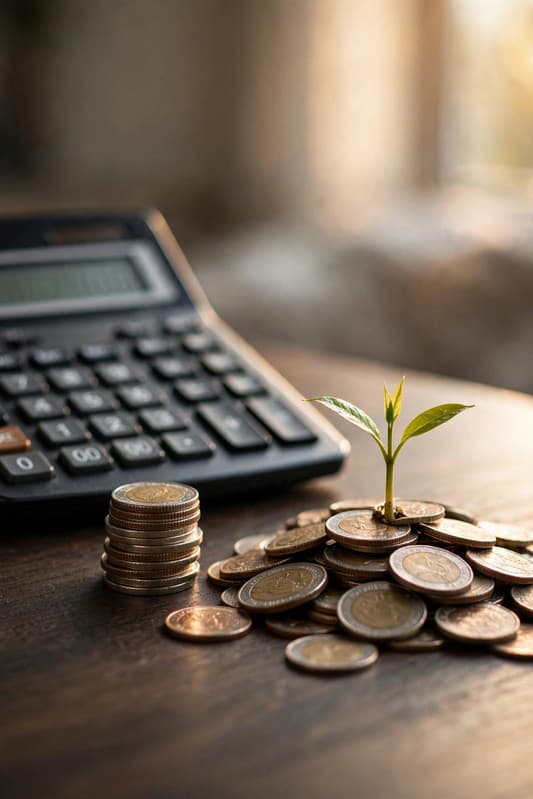
A bonus, a matured fixed deposit, a property sale or an inheritance often arrives as one large amount, not a monthly salary. The question that follows is always the same: if I invest this once and leave it alone, what could it become? A lumpsum calculator is the simplest tool for that question. It needs only three inputs — the amount, an assumed annual return and the number of years — and it applies one formula. This guide explains that formula in plain language, shows worked numbers you can check, compares a lumpsum with a monthly SIP using the same total money, and covers the tax and timing risks that calculators do not show you.
Quick Answer: A lumpsum calculator answers one question: what does money invested once today become later? At an assumed 12% a year, ₹5 lakh becomes about ₹15.53 lakh in 10 years, ₹27.37 lakh in 15 years and ₹48.23 lakh in 20 years. Those are illustrations from a formula, not promises — real returns vary every year.
The one formula every lumpsum calculator uses
Future Value = Amount x (1 + annual return) raised to the number of years. In symbols: FV = P x (1 + r)^n, where P is the one-time amount, r is the assumed annual return written as a decimal, and n is the number of years. There is no monthly instalment in this formula, because the whole amount starts working from day one. That single fact explains almost every difference between a lumpsum and a SIP: the lumpsum gets the full number of years of compounding on the full amount, while a SIP adds money gradually and later instalments get fewer years to grow.
Worked example — ₹5 lakh at an assumed 12% a year
All figures below use the formula above at an assumed 12% a year, compounded annually, before tax and charges. They are illustrations, not forecasts or promised returns. After 5 years: ₹5,00,000 becomes about ₹8,81,171. After 10 years: ₹5,00,000 becomes about ₹15,52,924. After 15 years: ₹5,00,000 becomes about ₹27,36,783. After 20 years: ₹5,00,000 becomes about ₹48,23,147. The same ₹5 lakh at 10% for 15 years becomes about ₹20,88,624, and at 8% for 15 years about ₹15,86,085 — a 4-percentage-point difference in assumed return changes the 15-year result by roughly ₹11.5 lakh. A larger starting amount scales in proportion: ₹10 lakh at an assumed 12% becomes about ₹31,05,848 in 10 years and about ₹54,73,566 in 15 years.
Lumpsum vs SIP — the same ₹5 lakh, two very different results
Take the same total money, ₹5 lakh, over the same 15 years at the same assumed 12%. Invested once on day one, it becomes about ₹27.37 lakh. Invested as ₹2,778 a month for 180 months (₹5,00,040 in total), it becomes only about ₹14.02 lakh. The gap is not magic and it is not a reason to prefer one route blindly: the lumpsum's full amount compounds for all 15 years, while the SIP's last instalments compound for only a few months. The trade-off is timing risk. A lumpsum invested just before a market fall starts underwater and needs patience to recover; a SIP buys through the fall at lower prices. If the money must be available soon, or if a fall would force a panic exit, the SIP's smoother ride can be worth the lower mathematical result. Calculators show the maths; they cannot measure your ability to stay invested.
What return should you type in? Use a range, never one number
No calculator knows future returns, so never trust a single figure. Run every calculation three times: at 8%, at 10% and at 12%. If your goal only works at 12%, the plan is fragile — either save more, extend the horizon or lower the goal. Also remember that the calculator's smooth annual rate hides real market behaviour: actual yearly returns swing above and below the average, sometimes sharply, and a single bad stretch early on changes the path even if the long-run average looks the same. Finally, adjust for inflation in your head: ₹27.37 lakh in 15 years at 5% annual inflation buys roughly what ₹13.16 lakh buys today. A nominal figure that looks large can still be a modest real gain.
STP — the middle path between all-at-once and monthly
A Systematic Transfer Plan (STP) is the common middle path. You park the lumpsum in a low-risk liquid or money-market fund and transfer a fixed amount into an equity fund every month, typically over 6 to 12 months. It reduces the risk of investing everything on one unlucky day, while still putting the money to work faster than a multi-year SIP. It is not free insurance: money waiting in the liquid fund earns lower returns, and if markets rise steadily during the transfer period, the STP ends up buying at higher prices than a day-one lumpsum would have. Use an STP when the amount is large relative to your total savings and a sudden fall would worry you into exiting — not as a default for every amount.
Tax on lumpsum gains — the part calculators skip
For listed equity shares and equity-oriented mutual funds held over 12 months, long-term capital gains above ₹1.25 lakh in a financial year are taxed at 12.5% (plus applicable surcharge and cess); gains on holdings under 12 months are short-term and taxed at 20%. As an illustration only, a ₹5 lakh lumpsum growing to about ₹27.37 lakh has a gain of about ₹22.37 lakh; after the ₹1.25 lakh exemption, roughly ₹21.12 lakh would be taxable at 12.5%, or about ₹2.64 lakh in tax, before surcharge and cess. Debt-oriented funds have different rules — gains on units acquired on or after 1 April 2023 are generally taxed at your income-tax slab rate — so check the fund type before applying any equity tax figure. Exit loads may also apply on early redemption. Tax rules change, and the government is currently reviewing capital-gains and securities-transaction-tax settings with no change announced yet, so confirm the current rates before acting.
Five mistakes lumpsum calculators cannot catch
1. Investing money you will need within 3 years into a market-linked fund — a short horizon turns normal volatility into a real loss.
2. Typing in last year's best return as the assumed rate — past performance is history, not a setting.
3. Ignoring the emergency fund — a lumpsum should never be money you may need for a job loss or medical bill.
4. Forgetting tax and exit load — the calculator's headline figure is pre-tax; the money you keep is smaller.
5. Checking the value daily and exiting on the first fall — the lumpsum's advantage comes entirely from staying invested for the full horizon.
What is a lumpsum investment?
How is a lumpsum return calculated?
Is lumpsum better than SIP?
What is a good assumed return to use?
Can I invest a lumpsum and also do a SIP?
Is lumpsum tax different from SIP tax?
Ready to start?
1. Decide the goal and the year you need the money — never invest short-term money in market-linked funds. 2. Run the calculator at 8%, 10% and 12% and check whether the goal survives the lowest case. 3. Compare all-at-once, STP over 6 to 12 months, and a monthly SIP before choosing. 4. Set aside tax on the gain in your head — the calculator figure is pre-tax. 5. Invest, then review once a year instead of watching daily prices.
Learn MoreThis article is for educational purposes only and is not financial advice. Please consult a SEBI-registered investment adviser for personalized guidance. Investments are subject to market risk.
Formula maths computed for this article (FV = P x (1 + r)^n, annual compounding, before tax and charges); equity capital-gains rates per the current Income-tax framework (LTCG 12.5% above ₹1.25 lakh exemption, STCG 20% for holdings under 12 months); debt-fund slab-rate treatment for units acquired on or after 1 April 2023. Returns are assumed illustrations, not actual fund performance.
Discussion
KEEP EXPLORING
More in Tools Your next good read.
Tools
SWP Calculator: How Long Will ₹1 Crore Last You?
7 min read
ToolsGoal Calculator: How Much to Save From November for ₹10 Lakh in 12 Months
6 min read
ToolsCAGR Calculator, Explained: How to Compare Any Investment's Real Growth Rate
9 min read
ToolsReverse SIP Calculator: How Much SIP for ₹50 Lakh in 10 Years?
9 min read