


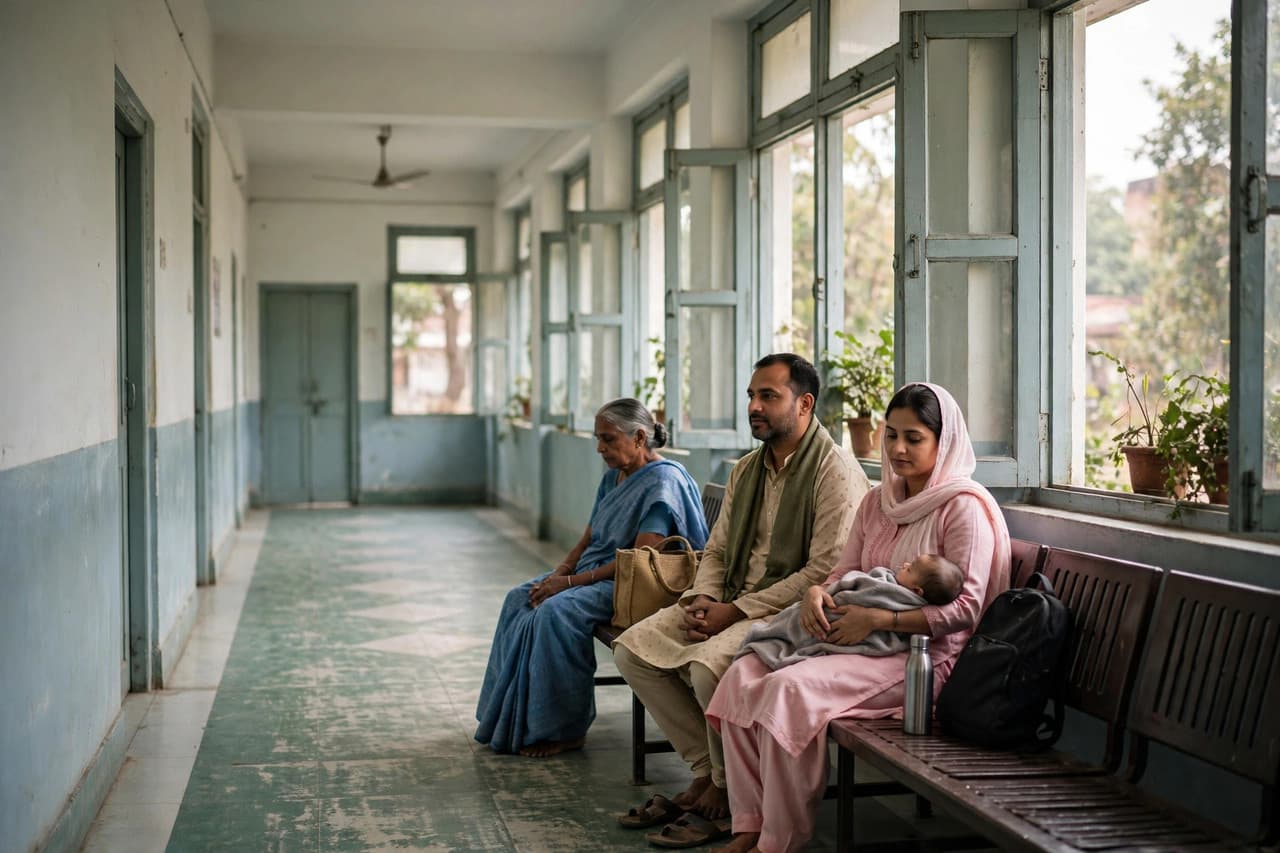
Rohan, 29, works in IT in Bengaluru. His employer gives him a ₹5 lakh family floater. Last month his father needed a cardiac procedure plus a week in ICU. The bill: ₹6.5 lakh. The cover paid ₹5 lakh; Rohan arranged ₹1.5 lakh from savings while his father was still in hospital.
Quick Answer: No — a ₹5 lakh employer group cover is a first layer, not full protection. ₹5 lakh is the most common sum insured, yet a cardiac procedure plus a week in ICU can cost ₹5.5–7 lakh while medical costs rise 11.5–14% a year. Keep the office cover; add your own base policy and a super top-up.
Why ₹5 lakh is the default
Group health insurance is now India's biggest private cover channel. In FY25, group policies covered 27.51 crore lives — nearly five times the 6.01 crore under individual retail policies — and wrote ₹61,435 crore of premium, about half the health market (IRDAI Annual Report 2024-25). For most working Indians, the employer's policy is their primary cover, not a top-up. And the amount is remarkably uniform: ₹3–5 lakh per employee, with ₹5 lakh the most common base sum insured (Plum HQ data, May 2026); larger IT and BFSI employers typically offer ₹5–10 lakh. The employer pays the whole premium, so few people question the number — but the cover amount was set years ago and does not grow on its own.What a real hospital bill looks like
Take Rohan's bill apart. A cardiac event — stenting, bypass or a complex angioplasty — in a private metro hospital costs ₹4–8 lakh. A week in ICU runs ₹1–3.5 lakh before treatment costs, at ₹15,000–50,000 a day (cost data reported May 2026). Cancer treatment with surgery easily crosses ₹10 lakh. A cardiac procedure plus a week in ICU typically totals ₹5.5–7 lakh. Now add medical inflation. Aon's 2026 Global Medical Trend Rates Report (December 2025) projects an 11.5% rise in Indian employee medical plan costs for 2026; Milliman's April 2026 report pegs the trend at 12% for 2024 and 13% for 2025; other industry data puts it up to 14%. At 13% a year, a ₹5 lakh procedure today costs about ₹9.2 lakh in five years, and a ₹6.5 lakh bill becomes roughly ₹12 lakh. Rohan's ₹5 lakh cover, unchanged, would pay barely 54% of that future procedure. The bill compounds. The cover stays flat.The five gaps in your office cover
1. It ends when you leave. Group cover belongs to the employment, not to you. Resign, get laid off, or move to an employer with no group policy, and the cover stops — usually the same month. Ask HR whether your insurer offers conversion to a retail policy at exit; do not assume it, or that the terms would match. 2. The amount is frozen in time. A ₹5 lakh sum insured bought three years ago has the purchasing power of roughly ₹3.5 lakh today at 13% medical inflation. Nobody re-rates it for you. 3. Room-rent caps shrink the payout. Many group policies cap room rent at 1% of the sum insured per day — ₹5,000 a day on a ₹5 lakh policy. Private hospital rooms in tier-1 cities commonly cost more, and picking a costlier room can trigger proportionate deduction on the whole bill, not just the room charges. 4. Co-pay and disease sub-limits. Some group policies add a co-pay — you pay 10–20% of every claim — or cap procedures such as cataract surgery, joint replacements or hernia. These sit in the fine print and surface at claim time. 5. Parents and maternity are limited. Parents are usually not covered unless you pay extra, at higher premiums and co-pays. Maternity sub-limits are commonly ₹50,000–₹1 lakh for a normal delivery, against actual private-hospital costs of ₹80,000–₹2.5 lakh.Group cover vs your own policy — the comparison
- Continuity (weight 30%): group cover ends when you leave the job; your own policy is yours for life if renewed. - Amount (weight 25%): group cover is usually ₹3–5 lakh and fixed; your own policy lets you choose ₹10 lakh or more. - Sub-limits (weight 20%): room-rent caps, co-pay and disease caps are common in group policies; in your own policy you pick the variant. - Portability (weight 15%): group conversion is limited and not guaranteed; in a retail policy, waiting periods and bonus carry when you port. - Cost to you (weight 10%): group cover is free because the employer pays; your own policy costs a premium, deductible under 80D in the old regime. Framework date: November 2026. Group cover wins on cost and loses on continuity and amount — the two are complements, not substitutes.The fix: base policy plus super top-up
The structure most salaried employees land on has two layers. First, keep the employer cover and let it absorb everyday hospitalisations. Second, buy your own base policy of ₹10–15 lakh — and add a ₹20 lakh super top-up with a ₹5 lakh deductible, which only pays above the deductible and costs a fraction of an equivalent standalone policy. (Our super top-up guide explains deductibles in detail.) Buy the personal policy young. Premiums are lower when you are young and healthy. The pre-existing-disease waiting period — capped at 3 years under IRDAI's Master Circular of May 2024 — starts ticking now, not when you fall ill. And claim-free years build a cumulative bonus that grows your cover without extra premium. Premiums you pay also qualify for deduction under Section 80D (₹25,000 a year; ₹50,000 for senior citizens) under the old tax regime.Your four checks this week
1. Open your HR portal and note your sum insured, room-rent cap, and whether parents are covered. 2. Ask HR: does cover continue if I leave, and is there a co-pay? 3. Price your own ₹10 lakh base policy plus a ₹20 lakh super top-up — compare it with your food-delivery spend first. 4. If you buy, do it before your next birthday — premiums rise with age, and the waiting clock only starts when the policy does.Does my employer's health cover end the day I quit?
Can I port my group policy to a personal one?
Is a super top-up better than simply raising my base cover?
Why did my premium rise if GST on health insurance is zero?
Ready to start?
Check your group cover amount, room-rent cap and co-pay on your HR portal today. Follow @myfwindia on Instagram for the daily checklist version of this guide. Get the myfw app on Google Play — 22+ calculators in your pocket.
Learn MoreEducational content only — not financial advice. Consult a SEBI-registered investment adviser for personal guidance; investments are subject to market risk.
Sources: IRDAI Annual Report 2024-25 (group 27.51 crore lives vs retail 6.01 crore; group premium ₹61,435 crore) via IRDAI Handbook Table 58; Aon 2026 Global Medical Trend Rates Report (Dec 2025, 11.5%); Milliman April 2026 report (12% for 2024, 13% for 2025); Plum HQ May 2026 (₹5 lakh most common base sum insured) via thesalaryinvestor.com; Coverton guide (cardiac ₹5.5–7 lakh, ICU ₹1–2 lakh/week, room-rent 1%, maternity sub-limits); IRDAI Master Circular on Health Insurance Business, 29 May 2024 (PED waiting capped at 3 years, moratorium 5 years); Economic Times, 21 Nov 2026 (IRDAI ₹2 crore penalty on Star Health — claims context).