


Imagine pulling into a petrol pump and being turned away — not because you cannot pay, but because your car's insurance lapsed last week. That is one of three changes the government is now testing for motor insurance.
Quick Answer: The government is considering three motor-insurance changes, reported on 25 November: a "no insurance, no fuel" pilot at 10 petrol pumps, premiums linked to your traffic challans, and single-premium four-year car and six-year bike cover. None is a nationwide rule yet. Third-party cover is already compulsory, and driving without it draws a Rs 2,000 fine.
The three proposals in one minute
The road transport ministry is examining three proposals, reported on 25 November 2026. First, premiums could be linked to the traffic offences recorded against a driver in the previous year, so repeat violators pay more than careful drivers. Second, owners may be able to buy single-premium cover lasting four years for cars and six years for two-wheelers, paying once instead of renewing every year. Third, a "no insurance, no fuel" pilot would test whether uninsured vehicles can be refused fuel at petrol pumps. None is a nationwide rule yet: no start date has been fixed and no premium table has been published. The Supreme Court's Committee on Road Safety has asked the road transport and petroleum ministries to run the fuel pilot, following the Supreme Court's 4 August 2026 judgment in National Insurance vs Thungala Dhana Laxmi, which also directed four-year third-party cover for new cars and six-year cover for new two-wheelers."No insurance, no fuel": how the 10-pump pilot would work
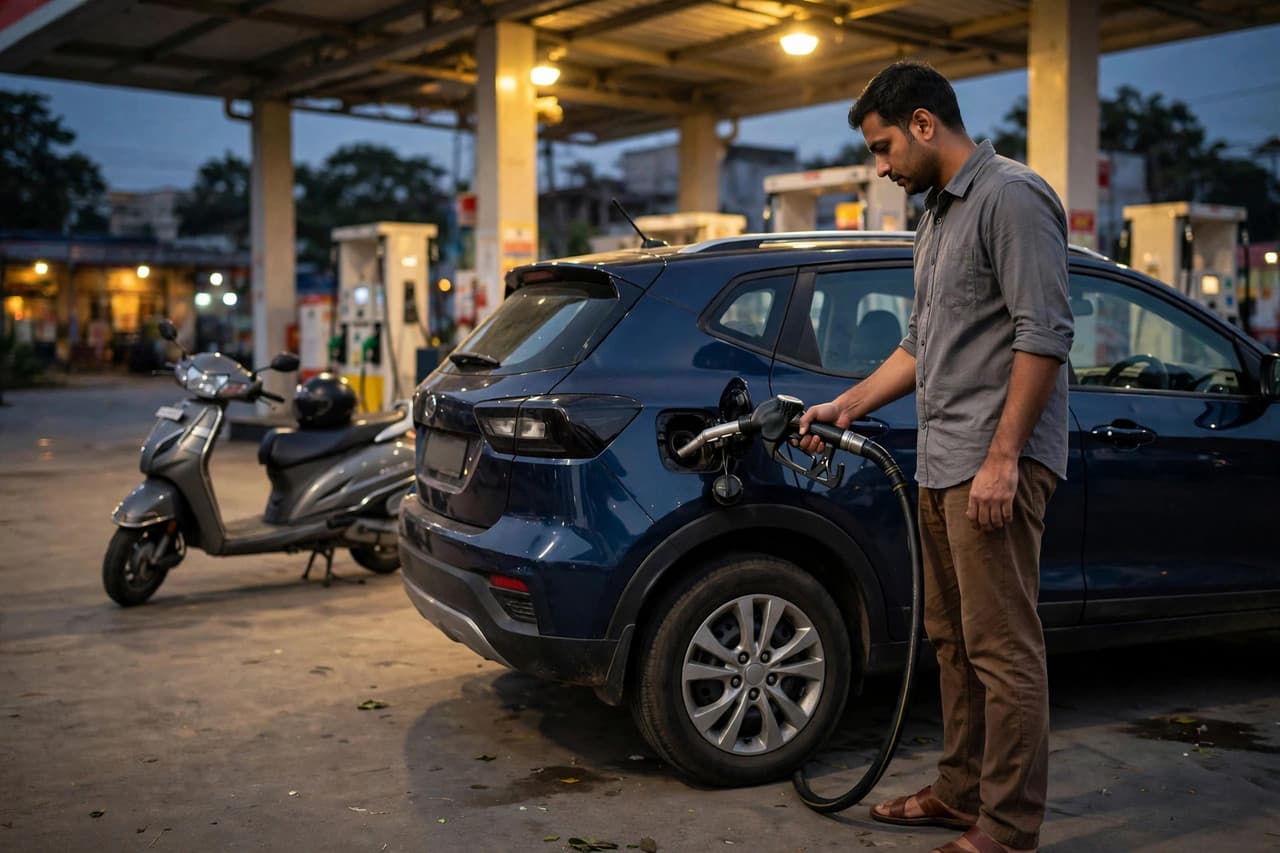
The pilot is deliberately small: five petrol pumps in Haryana and five in Uttar Pradesh, fitted with automated number-plate recognition (ANPR) cameras. The cameras read each vehicle's registration number and check whether it has valid insurance before fuel is dispensed. No launch date has been announced and the ten pumps have not been named. The pilot tests whether the technology and the checking process work. It is not a nationwide rule, and no such instruction exists today. Third-party motor insurance is compulsory, yet millions of vehicles run without it. When an uninsured vehicle causes an accident, victims can struggle to secure compensation, because there is no insurer to pay. The pilot tries to close that gap at the one place every vehicle eventually shows up: the petrol pump.The numbers: 25 crore insured, about 5.9 crore not
Insurance data cited by The Economic Times on 25 November puts the scale plainly. Nearly 25 crore active vehicles currently have valid insurance — around 81% of the vehicles running across the country. Coverage varies sharply: more than 90% of heavy commercial vehicles are insured, and around 88% of cars. About 80% of two-wheelers are insured. Three-wheelers are lowest, at around 57%. Derived from those two figures: 25 crore at 81% implies about 30.9 crore active vehicles in total, leaving roughly 5.9 crore — about one in five — without valid insurance. Two-wheelers are the biggest gap in absolute terms — the largest class, a fifth uninsured; three-wheelers are worst by rate, at 43%.What driving uninsured actually costs you
The fine is the smallest part of the cost. Third-party insurance is compulsory under Section 146 of the Motor Vehicles Act, 1988. Under Section 196, a first offence draws a fine of Rs 2,000 and/or up to three months' imprisonment; a repeat offence, Rs 4,000 and/or up to three months (Press Information Bureau). Take Rohit, 32, who rides an uninsured scooter in Gurugram. Caught at a check, he pays Rs 2,000; caught again, Rs 4,000. But the fine is not the real risk: if his scooter hits a pedestrian, the third-party liability for injury or death is effectively unlimited, and with no policy the entire bill falls on Rohit. An illustrative Rs 5 lakh hospital and compensation bill is 250 times the Rs 2,000 fine — the claim, not the fine, is what can wipe out years of savings. The same caution applies to challan-linked premiums: no offence list, formula or rate table has been published — the ministry is "working on a mechanism" to use previous-year offences. Any claim that jumping a red light adds a specific percentage to your premium is invented. A clean driving record is likely to matter more than it does today.Your checklist before 15 December
One date is already fixed. IRDAI's four-layer motor insurance framework — circular IRDAI/CIR/MOT/10/2026, dated 2 November 2026 — takes effect for policies issued from 15 December 2026, splitting a motor policy into four parts with standard wording across insurers: third-party cover (mandatory), legal liability towards passengers (optional), personal accident cover (mandatory for the owner), and own-damage cover (optional). We explained it in our 5 November guide; at your next renewal, you will tick each part deliberately instead of buying a bundled policy on autopilot. Scored on 27 November 2026 on how soon each proposal could bite you (40%), how much it could cost (35%), and what you control today (25%), the verdict is a checklist, not a ranking — so do this now: 1. Check your motor policy's expiry date today and set a renewal reminder seven days before it. 2. Never let the policy lapse, even for a week — every lapsed day is a day you are driving uninsured. 3. Keep your challans clean — your record may feed your next premium. 4. At renewal after 15 December, tick the four parts of the new format deliberately. 5. Buying a new car or bike? Ask about the four-year or six-year single-premium option when it arrives.Will I really be refused petrol without insurance?
Will my premium rise if I jump a red light?
Do I have to buy a four-year policy for my car now?
What changes on 15 December 2026?
Ready to start?
Check your motor policy expiry date today and set a renewal reminder 7 days before it. Follow @myfwindia on Instagram for the daily checklist version of this guide. Get the myfw app on Google Play — 22+ calculators in your pocket.
Learn MoreEducational Purpose & Non-Advisory Notice: myFinance Wisdom provides personal finance tools, calculators, and information for educational purposes only. We are not a SEBI-registered Investment Adviser (RIA) or Research Analyst (RA). Nothing published on this platform constitutes tailored investment recommendations or financial advice. Securities and mutual fund investments are subject to market risks. Read all scheme-related documents carefully before investing.
Educational content only — not financial advice. Consult a SEBI-registered investment adviser for personal guidance; investments are subject to market risk.
Sources: The Economic Times, "Car, bike insurance rules may change: Govt plans higher premiums, no fuel without insurance", 25 Nov 2026; Business Today, "Your traffic record could soon affect your vehicle insurance premium", 26 Nov 2026; ET BFSI, "Revolutionizing Motor Insurance: IRDAI's New Four-Part Structure Effective December 15", Nov 2026; Press Information Bureau, Motor Vehicles Act Section 196 penalties; IRDAI circular IRDAI/CIR/MOT/10/2026, 2 Nov 2026.