


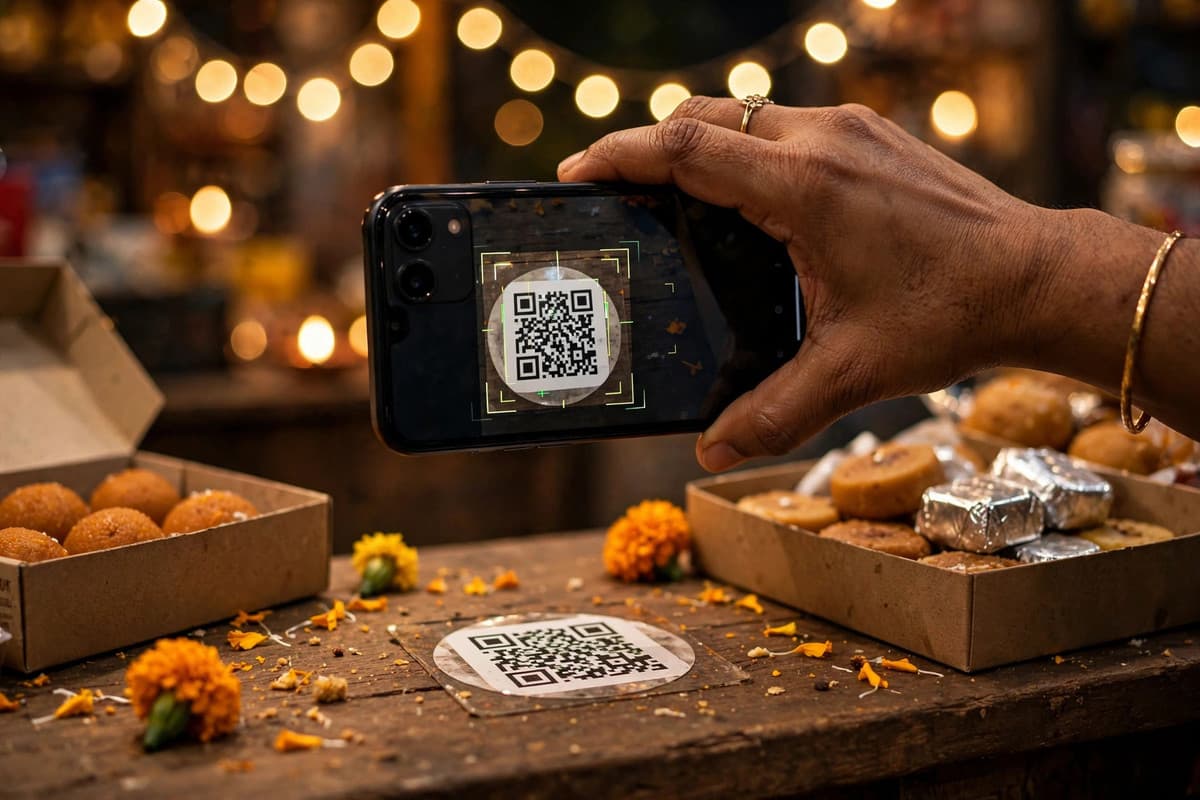
You pay ₹5,000 by UPI at an electronics store. The shopkeeper points at a sign: "UPI charge ₹20 extra." Do you pay it? After NPCI's filing in the Supreme Court on 3 November 2026, the answer is no.
Quick Answer: NPCI told the Supreme Court on 3 November 2026 that merchants cannot pass UPI charges to customers and UPI apps cannot levy platform fees. The 0.4% MDR applies only to person-to-merchant payments above ₹2,000 — about 4% of merchant transactions — and the merchant bears it. Your payments up to ₹2,000, and every person-to-person transfer, stay free.
What NPCI told the Supreme Court on 3 November
NPCI filed a counter-affidavit on 3 November 2026 in a case challenging the UPI merchant discount rate (MDR) framework — Anjan Datta v. Union of India. The Supreme Court had refused a stay on 28 September 2026 and asked the government and NPCI to explain the move.
The core point is who pays. MDR is a commercial charge on the merchant — not a tax, and not a fee from the customer. Merchants are "strictly prohibited" from passing it on, and UPI apps cannot impose platform fees. NPCI told the court this is a mandatory, binding direction, not an assurance: a bank or app that lets the charge reach customers breaches its NPCI agreement and faces action up to termination of its UPI membership.
The chain: the Taxation and Other Laws (Amendment) Act, 2026 rewrote Section 10A of the Payment and Settlement Systems Act; the Finance Ministry's notification S.O. 5067(E) of 14 September 2026 protected RuPay debit and UPI up to ₹2,000; NPCI's circular of 15 September 2026 set the rates above that line. The zero-MDR era that began on 1 January 2020 ended there.
The charge, in plain numbers: who pays what
The framework applies only to person-to-merchant (P2M) payments above ₹2,000. The rate is 0.4% of the value, capped at ₹300 for tickets of ₹75,000 and above. Railways, telecom, insurance, fuel and farm inputs above ₹2,000 pay a flat ₹5 instead. Mutual fund and securities transactions pay 0.02%, also capped at ₹300.
Two groups stay outside entirely. Person-to-person transfers are free at any value — about 70% of all UPI transactions. Small merchants in the P2PM category (up to ₹1 lakh a month in UPI credits) pay zero MDR at any ticket size. NPCI told the court roughly 96% of merchant transactions are ₹2,000 or below, so the charge touches only about 4%.
Rollout was set for 15 October 2026 and has since been postponed. Reports point to 1 January 2027, but NPCI has not notified a new date — treat that as a pointer, not a promise.
Three payments, three answers
Take Priya, who pays ₹5,000 by UPI at an electronics store. The MDR is 0.4% — ₹20 — and the merchant bears it. Priya pays ₹0 extra. If the store adds a ₹20 "UPI charge" to her bill, that surcharge is barred under NPCI's framework.
A ₹1,00,000 furniture order: at 0.4% the charge would be ₹400, but the cap cuts it to ₹300, again borne by the merchant. A ₹1,500 grocery payment? No MDR at all — below ₹2,000, nothing is charged to anyone.
The maths is the point: the charge is small, it falls on the merchant, and for 96% of merchant payments it does not exist. What has changed is not your bill — it is who funds the rails.
What stays free: the 96% that never changes
For most people, nothing changes. Every payment to a friend or family member stays free at any value. Every payment to a shop up to ₹2,000 stays free. Payments to a small merchant — the vegetable vendor, the neighbourhood kirana — stay free at any value under the P2PM category (up to ₹1 lakh a month).
October 2026 shows the scale: UPI processed 25.47 billion transactions worth ₹31.53 lakh crore — the first month past 25 billion and past ₹30 lakh crore. The network now handles about 89% of India's digital payments. That is the context: the rails got very big, and very expensive to run.
If a shop adds a "UPI charge" to your bill
First, check the amount: at ₹2,000 or below, no MDR exists, so any UPI charge is wrong on its face. Above ₹2,000 the MDR exists — but it is the merchant's cost, and passing it to you is barred.
Keep the bill and a screenshot showing the extra charge, and raise it with your payment app or bank — enforcement in NPCI's affidavit runs through the payment providers, whose agreements with NPCI forbid the pass-through. There is no single NPCI complaint portal for this; the remedy is contractual, through the provider.
One honest caveat: the affidavit stops the visible surcharge, not the invisible one. A merchant can still fold higher costs into prices — NPCI argues the charge is too narrow, at about 4% of merchant transactions, to be worth doing across a price list. Whether that holds is something to watch.
Why NPCI says the fee is needed
The funding gap is why the charge exists. The Finance Ministry estimates the industry's annual UPI operating cost at ₹20,700 crore, against a ₹2,000 crore budget allocation for 2026-27 — under 11% of the cost. The incentive scheme that kept the rails free peaked at ₹3,631 crore in FY24 and was cut sharply after that. The Parliamentary Standing Committee recommended a self-reliant, tiered revenue model, and NPCI's case is that 0.4% on the largest 4% of merchant transactions is the narrowest way to fund the network without touching everyday free payments.
The Supreme Court has approved nothing yet — no stay, no validation either. The framework waits on a notified start date and a judgment. What is settled is the consumer position: the charge, whenever it starts, is the merchant's, not yours.
Educational content only — not financial advice. Consult a SEBI-registered investment adviser for personal guidance; investments are subject to market risk.
Sources: LiveLaw, 5 November 2026; Medianama, 6 November 2026; Cashless Consumer Fintech Weekly, 8 November 2026; NPCI circular, 15 September 2026; Finance Ministry notification S.O. 5067(E), 14 September 2026.
Will I pay extra for UPI payments above ₹2,000?
When does UPI MDR start?
Is there a charge on UPI payments to friends and family?
What should I do if a shop adds a UPI charge to my bill?
Ready to start?
Next time a shop adds a "UPI charge" above ₹2,000, ask for the bill in writing and raise it with your payment app — the charge is the merchant's, not yours. Follow @myfwindia on Instagram for the daily checklist version of this guide. Get the myfw app on Google Play — 22+ calculators in your pocket.
Learn More